http://sg.news.yahoo.com/blogs/property-blog/record-setting-property-prices-singapore-125657536.html?utm_source=dlvr.it&utm_medium=twitter
By Getty Goh, a Masters graduate in Real Estate and a Bachelors in Building from the National University of Singapore.

On 10 Apr 2013, news came out that Wing
Tai Holdings Chairman Cheng Wai Keung was offering to sell his 85,000 sq
ft (7900sq m) bungalow for as much as S$300million. It was reported
that if that deal went through, it would set the record as the most
expensive Singapore residential property ever sold.
Naturally, this made us wonder how many
of such outrageously priced transactions were there. My team also
thought that it would be interesting to find out what the
record-breaking prices for non-landed properties were as well. After a
quick search, our findings are as follows…
The most expensive landed property transaction goes to…
Based on the transaction data from URA,
we found that since 1995, as many as 999 detached landed properties were
sold for more than $10,000,000. However, the top 5 most expensive
landed property transactions that crossed hands are shown in Figure 1.
Figure 1: Most expensive landed properties transactions
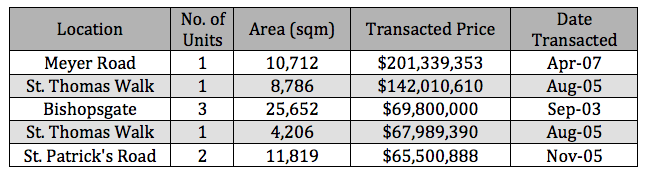
Fig A1
Source: URA and Ascendant Assets Pte Ltd
Looking at the table above, it does not
come as a surprise that all of the developments were Good Class Bungalow
(GCB). Based on URA, GCBs need to have a minimum plot size of
1,400 sqm. It is important to note that foreigners and PRs are not
allowed to buy landed properties that are more than 1,400sqm. In other
words, wealthy Singaporeans made these purchases. As land is a scarce
resource in Singapore, there is a limited number of GCBs available.
Hence, it does not come as a surprise that GCB owners are able to
command premium prices for their assets.
The most expensive non-landed property transaction goes to…
Based on the transaction data from URA,
there were 574 non-landed properties that were sold for more than
$10,000,000 and the top 5 most expensive non-landed properties are shown
in Figure 2.
Figure 2: Most expensive non-landed properties transactions

Fig A2
Source: URA and Ascendant Assets Pte Ltd
Based on the table, we can see that with
exception of the Boulevard Residence, the rest are all condominiums. Not
surprisingly, all these are freehold projects and are located within
Singapore’s prime location of districts 9 and 10.
Conclusion
Looking at how high the record setting
prices are, I believe it is hard for many of us to fathom why anyone
would pay so much for a property. However, in an article published by
Boston Consulting Group in Jun 2012, it was reported that the number of
Singapore households with investable assets of more than US$1milion (or
S$1.26 million) rose 14 percent to 188,000 in 2011. Based on this
figure, it means that one in six households is a millionaire. The
'ultra-high-net-worth' households, defined as households with over
US$100 million (S$129 million) in private financial wealth, also grew
with 10 in every 100,000 households being in that category.
Mark Twain, a famous American author once
said, “Buy land, they ain’t making it anymore”. Those who had the
foresight to invest in Singapore properties in the 1970s and 1980s, when
they were still comparatively affordable, would be sitting on gold
mines right now. For those who missed the Singapore property boat,
perhaps some of the developing countries overseas could be the next gold
mines that Singapore property investors are looking for.


No comments:
Post a Comment